Kin
A new project to help siblings get paid by Medicare to care for mom and dad
Originally published on Wandering Founder .
Dear Friends,
Today, I’m sharing a project called Kin to help kids get paid for taking care of their aging parents and we’re looking for founding doctors in CA who believe in this concept and want to help make it happen.
Origin
In 2023, I almost lost my Dad’s to open-heart surgery . This was one of the hardest moments in my life and this experience has inspired me to think hard about eldercare and what it would take for my dad to stay healthy and strong into his 70s and 80s. A few months ago, my cofounder Kev and I also sold Downtobid so eldercare naturally became a thread for a future problem to solve.
Two questions keep circling my mind
“How come I wasn’t aware of my dad’s declining health until I almost lost him?”
“Why did this happen and why do these problems exist in eldercare?”
How we got inspired by caretaking stories
One thing I learned from my Downtobid journey is that the first step to solving a problem always starts with listening to stories. So last month, Kev and I asked friends, family and colleagues to share their experiences caring for their aging parents.
- When did your mom and dad get sick?
- What did your day-to-day look like as a caretaker?
- How did you handle insurance, doctor visits, prescriptions?
- What was it like to see your dad get sicker?
- If you could pick one thing to improve about this process, what would it be and why?
One friend Ashlee left San Francisco in her 20s (her job, her friends, her community) to move back home when her mom got ill. She did this because she couldn’t trust the secondhand account she was getting from her parents about what the doctor actually said, since they didn’t want her to worry. The only way to know what was really going on was to be in the room.
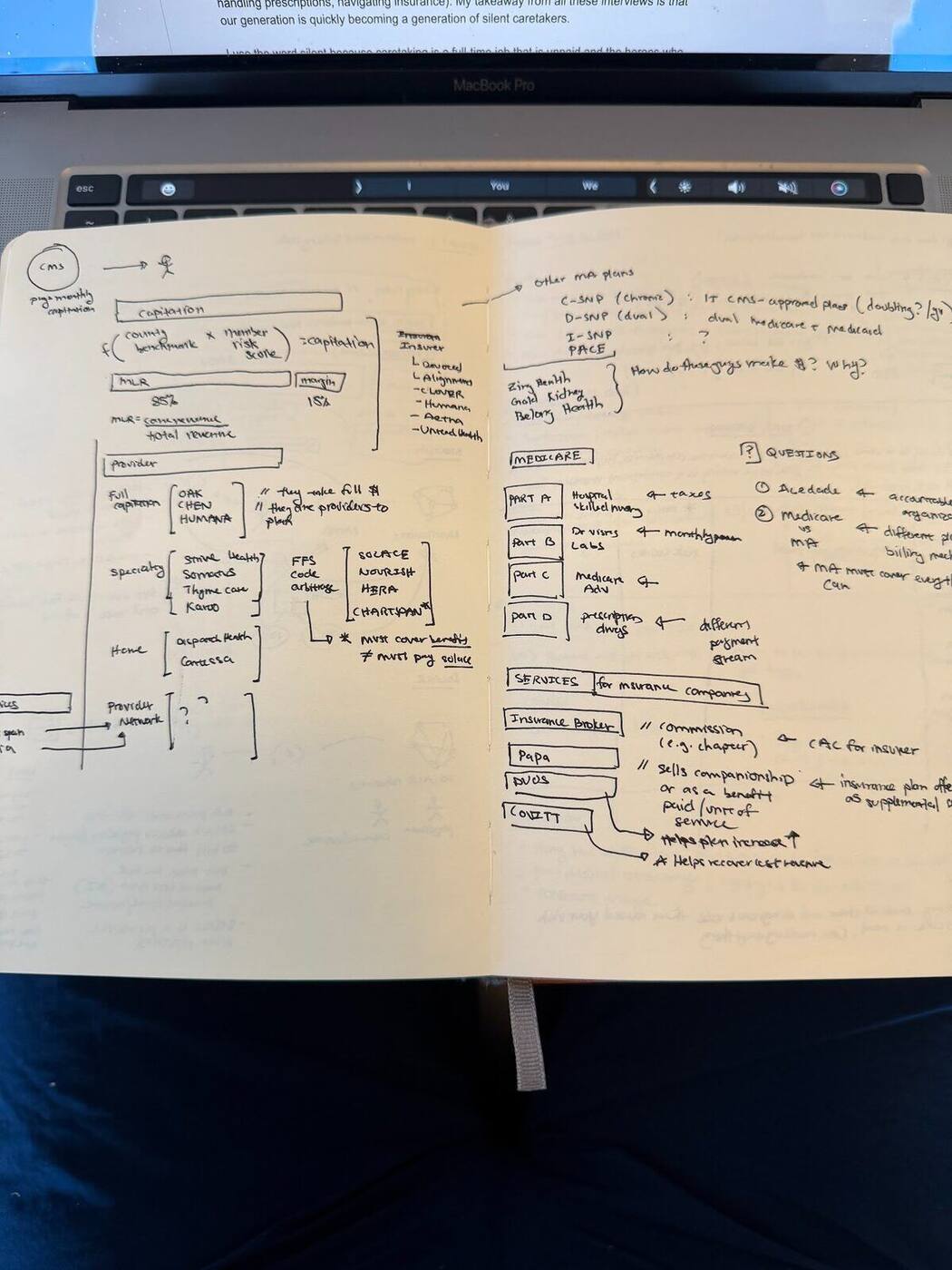
A glimpse into my notebook as I started to learn about Medicare
Silent caretakers are heroes
My family’s caretaking experiences. The caretaking experiences of Ashlee. Every family has their own story, but there’s pain in every story. This NYT opinion piece is representative of that pain. As I write this, I feel emotional knowing how much pain there is in this space.
What strikes me is how certain themes keep appearing.
For instance, our parents often hide how bad it actually is. Ashlee’s parents softened the doctor’s notes on purpose so their daughter wouldn’t worry. I often caught my mom and dad leaving out crucial details when dad’s surgeon talked about the risks and mortality rate of his open-heart surgery. I think it’s because no parent wants to ever feel like they are a burden to their kids. Parents are supposed to protect their kids. Imagine the guilt that one feels when the roles are reversed and our parents begin to recognize their fragility. Then contrast that with the other side – how upset we get when we realize our parents are lying to us about their own health and actively obstructing the process of getting healthier. Both sides are justified and it’s just one example of the messy emotions that come with caretaking.
Those of us who have gone through any form of caretaking know that caretaking for a sick parent evolves into an all-consuming job (coordinating doctor visits, researching therapies, handling prescriptions, navigating insurance). My takeaway from all these interviews is that our generation is quickly becoming a generation of silent caretakers.
I use the word silent because caretaking is a full-time job that is unpaid and the heroes who take it on make major sacrifices in life. This sacrifice is often unrecognized.
In my family, that’s Annie (my oldest sister). She’s a hero because she makes sure that my dad gets to all his doctor appointments, that our family group-chat is updated with his medical records and notes and that he takes all his prescriptions. From all my conversations, every family has their own Annie that is silently doing the work and has to make big sacrifices in their lives to care for an aging parent and it means giving up large parts of their own lives to do so (career, social, partner, children).
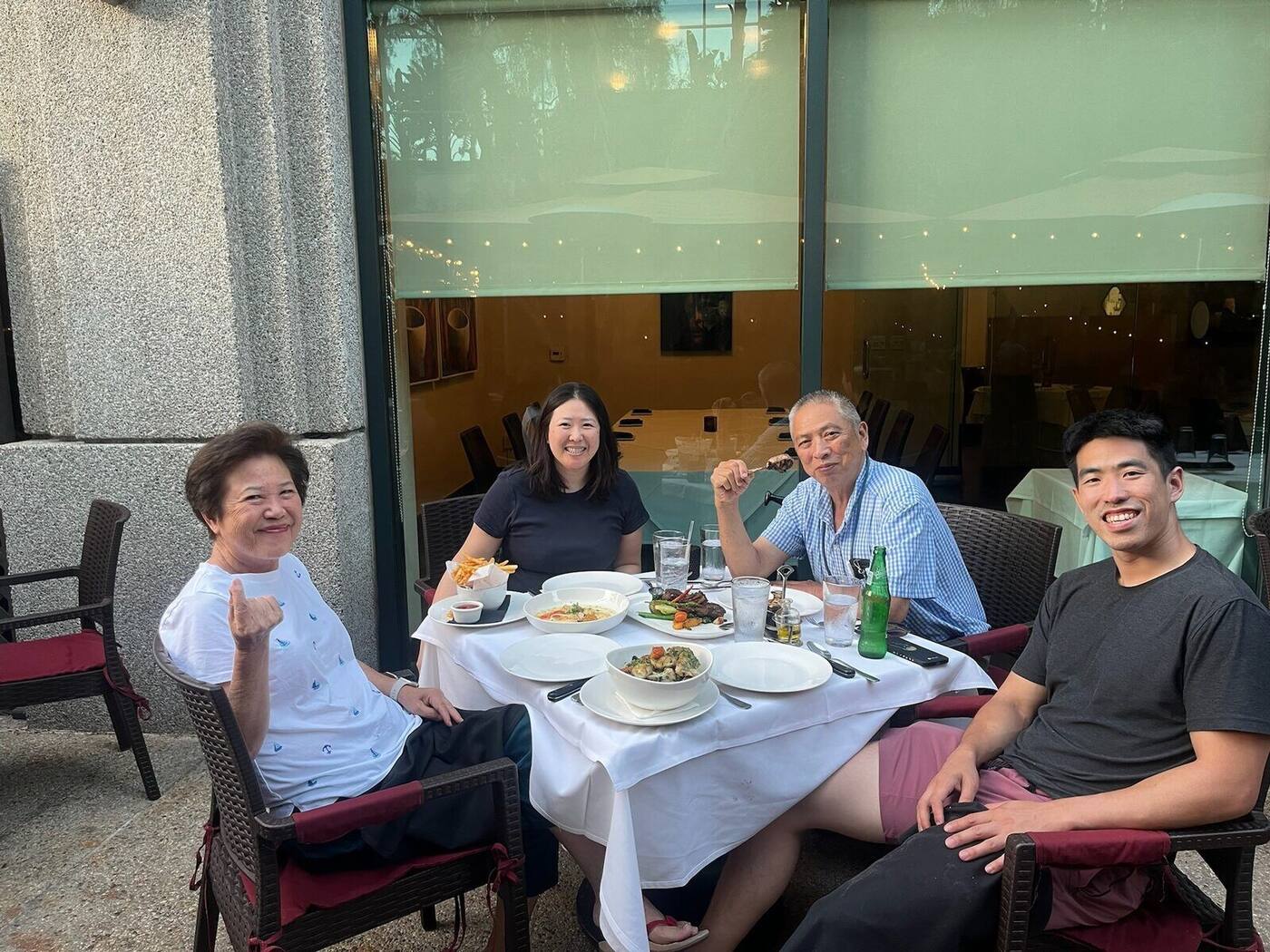
Annie’s a real hero, but she always makes me pay for dinner w/ Mom and Dad :(
PIN / CHI medical codes
We want to help silent caretakers like Annie get paid for their work.
A few years ago, Medicare introduced two billing codes PIN (principal illness navigation) and CHI (Community Health Integration). The goal of these codes is to give families a dedicated care-coordinator who can handle the day to day coordination of caretaking (scheduling appointments, negotiating with insurance, etc). The bet is that a senior with this resource is more likely to get the medical help they need early-on and ultimately avoid hospitalization. Because hospitalizations are so expe medicare is highly incentivized to prevent hospitalizations and PIN/CHI is one way to do so.
This code is still unknown to most seniors on medicare so two startups have already launched businesses to make this service easily accessible (Hera and Solace Health ).
Introducing Kin
We believe the premise of PIN/CHI is correct. Unlike Hera and Solace, however, we believe the care coordinator is already in the family because the best caretaker for your parents is you and your siblings.
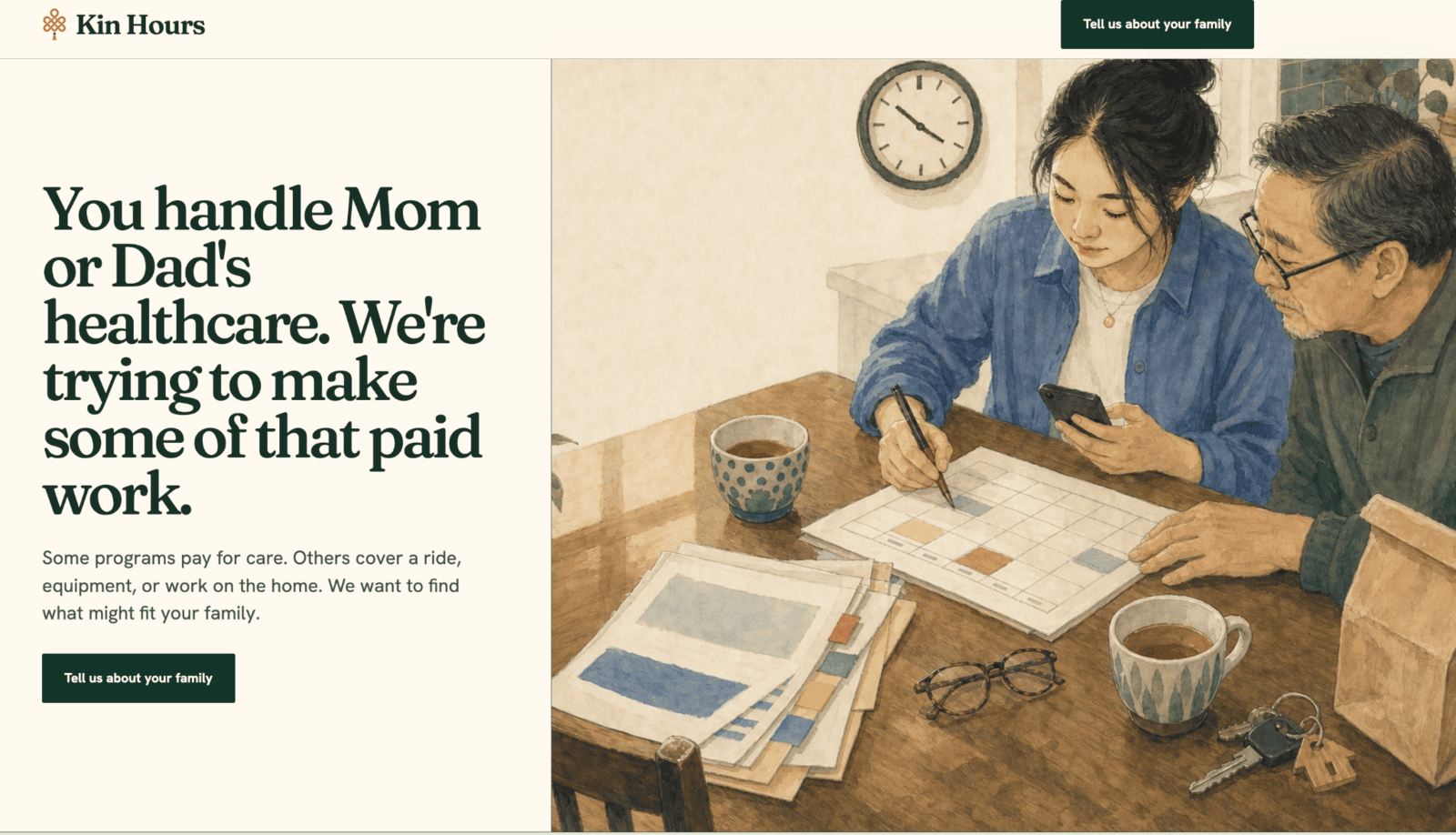
We also believe that family caretakers should be paid for coordinating mom and dad’s care. It helps the family and it helps offset hospitalizations, an expensive cost to the US healthcare system. The goal of Kin is to turn every household’s silent caretaker into a paid caretaker.
So why doesn’t this exist?
In order for a care-coordinator to get paid, they need to be supervised by a physician who owns a PC (professional-corporation) that is approved to bill medicare. Additionally, the care coordinator needs to be a W-9 contractor that is employed by an MSO (management-services-organization); the MSO partners with the PC. There is also a long list of compliance line-items in order to authorize payment. This entire process takes thousands of dollars and weeks (potentially months) to setup and no one in their right mind is going to go through the steps of finding a physician, setting up these legal entities, ensuring compliance only to get paid $72/hour (the current wage that medicare pays for care-coordination.
What Kin is going to do is solve all the legal/compliance/entity-setup problems on the backend and make it dead-simple for family care coordinators to bill medicare in a compliant and legal way. We’re then going to charge a flat fee similar to how Mark Cuban’s company Cost Plus Drugs does.
We probably won’t make much money on PIN/CHI, but getting even one family paid for work they’re already doing would be a real win and a first step to improving eldercare. We’re starting with a few doctors and a few families in California.
Ask
Legally, we cannot stand up Kin unless we have a small group of founding doctors in CA who believe in this idea and want to work with us to enable this service for all families in CA. We also think there is an interesting opportunity for doctors to make passive income by helping families navigate their care plan, which is a win-win-win for all 3 parties (doctors, families, medicare system).
Between us, the founding doctors and the first set of families, we’ll work together to build care-plans for our first set of aging parents and figure out the product experience to make this entire care-coordination process simple and useful for all families.
If you are a doctor or know a doctor who would be excited to collaborate on this, please get in touch by sending me an email andylee024@gmail.com . We would be incredibly grateful!